
Algebra 2 Honors Textbook PDF: A Comprehensive Guide
Finding a readily available PDF version of an Algebra 2 Honors textbook can be challenging, yet crucial for accessible learning and efficient study habits․
Resources like McGraw Hill’s 2008 edition, alongside options from CK-12 Foundation and Teaching Textbooks, Inc․, offer viable alternatives for students seeking digital materials․
These platforms provide comprehensive coverage of core concepts, ensuring a solid foundation in advanced algebraic principles, and often include supplemental resources for enhanced understanding․
Understanding the Demand for PDF Textbooks


The increasing demand for Algebra 2 Honors textbook PDFs stems from a confluence of factors centered around accessibility, cost-effectiveness, and convenience for modern students․ Digital formats eliminate the burden of carrying heavy physical textbooks, offering portability through laptops, tablets, and smartphones․
Furthermore, PDF textbooks often represent a more affordable alternative to traditional printed copies, particularly beneficial for students facing financial constraints․ The open-content, web-based FlexBook model pioneered by CK-12 Foundation directly addresses textbook costs, making quality educational materials available to a wider audience․
The ability to search, highlight, and annotate directly within a PDF enhances the learning experience, fostering active engagement with the material․ Online resources and supplemental materials, easily linked within digital textbooks, provide additional support and practice opportunities․ This digital shift aligns with evolving pedagogical approaches that emphasize technology integration in education, catering to diverse learning styles and preferences․
Availability of McGraw Hill Algebra 2 (2008)
Locating a free and legal PDF of the McGraw Hill Algebra 2 textbook (2008 edition) presents challenges․ While the textbook itself is a widely recognized resource, direct downloads from McGraw Hill’s official website are typically restricted to licensed users or require purchase․
However, various online platforms and educational resource repositories may host scanned or digitized copies, though their legality and quality can vary significantly․ Valley View Public School Community Unit District 365U previously utilized this edition, suggesting potential archived resources within school districts․
Students should exercise caution when downloading from unofficial sources, prioritizing reputable websites and verifying file integrity to avoid malware or incomplete versions․ Exploring library databases and interlibrary loan programs can also provide access to digital or physical copies․ Consider supplemental materials and online calculators alongside the textbook for a comprehensive learning experience․
CK-12 Foundation’s FlexBook Alternative
CK-12 Foundation offers a compelling alternative to traditional Algebra 2 Honors textbooks with its FlexBook program․ As a non-profit organization, CK-12 is dedicated to reducing textbook costs and increasing access to quality educational materials for K-12 students globally․
The FlexBook model utilizes an open-content, web-based, and collaborative approach, allowing for the creation and distribution of high-quality, adaptable educational content․ This means students can access Algebra 2 materials online, often at no cost, and customize their learning experience․
CK-12’s resources can serve as a core text or supplement existing curricula, providing adaptive learning opportunities․ The platform’s flexibility and accessibility make it a valuable resource for students seeking affordable and comprehensive Algebra 2 Honors support, offering a modern approach to textbook learning․
Teaching Textbooks, Inc․ – A Complete Curriculum Option
Teaching Textbooks, Inc․ presents a comprehensive, self-paced curriculum for Algebra 2 Honors, offering a complete package for students seeking a structured learning experience․ Their materials include a student textbook, a detailed answer key and test bank, and supplementary CDs for lectures and practice exercises․
This all-in-one approach is designed to facilitate independent learning, with clear explanations and step-by-step solutions․ The inclusion of test solutions and practice CDs allows students to thoroughly assess their understanding and reinforce key concepts․
While not a free PDF resource, Teaching Textbooks provides a robust alternative to traditional textbooks, particularly beneficial for students who thrive in a self-directed learning environment․ The complete package ensures students have all the necessary tools for success in Algebra 2 Honors, fostering a strong grasp of mathematical principles․

Key Chapters Commonly Found in Algebra 2 Honors
Algebra 2 Honors typically covers foundational topics like integers, linear equations, systems of equations, and functions, progressing to advanced concepts like polynomials and trigonometry․
Chapter 1: Foundations of Algebra – Integers and Rational Numbers
This initial chapter lays the groundwork for all subsequent Algebra 2 Honors concepts, meticulously reviewing and expanding upon fundamental arithmetic principles․ Students will delve into the properties of integers, mastering operations like addition, subtraction, multiplication, and division, alongside exploring the nuances of absolute value and order of operations․
A significant portion focuses on rational numbers – fractions and decimals – emphasizing their representation, comparison, and manipulation․ This includes converting between fractions, decimals, and percentages, and performing arithmetic operations with these numbers․
Understanding the number line and its application to representing integers and rational numbers is crucial․ The chapter often incorporates real-world applications to demonstrate the practical relevance of these concepts, solidifying student comprehension and preparing them for more complex algebraic manipulations later in the course․ A strong grasp of these foundations is essential for success․

Chapter 2: Linear Equations and Inequalities
Building upon foundational algebraic principles, this chapter centers on mastering linear equations and inequalities – cornerstones of algebraic problem-solving․ Students will learn to solve equations in one variable, employing techniques like isolating the variable and applying inverse operations․ Emphasis is placed on understanding the properties of equality and how they maintain balance during equation manipulation․
Inequalities are introduced, with students learning to represent solutions graphically on a number line and express them using interval notation․ Solving compound inequalities and absolute value equations/inequalities are key skills developed․
Real-world applications, such as modeling linear relationships and constraints, are frequently incorporated․ Graphing linear equations, determining slope and intercepts, and writing equations from given information are also central to this chapter, providing a visual and analytical understanding of linear functions․
Chapter 3: Systems of Equations and Inequalities
This chapter delves into the realm of systems – sets of two or more equations or inequalities considered simultaneously․ Students will master techniques for solving systems of linear equations, including graphing, substitution, and elimination (addition/subtraction)․ Understanding the meaning of solutions – points of intersection – is paramount, representing values that satisfy all equations within the system․
The chapter extends to solving systems of linear inequalities, requiring students to graph the inequalities and identify the solution region – the area where all inequalities are satisfied․ Applications involving real-world scenarios, like optimization problems, are frequently explored․
Advanced topics may include solving systems involving non-linear equations and inequalities, further challenging students’ analytical and problem-solving abilities․ A strong grasp of these concepts is crucial for subsequent topics in Algebra 2 Honors․
Chapter 4: Functions and Their Graphs
This foundational chapter rigorously examines functions – a core concept in Algebra 2 Honors․ Students will define functions, identify their domain and range, and evaluate them for specific inputs․ Emphasis is placed on function notation (f(x)) and interpreting its meaning․
Graphing functions is a central skill, covering linear, quadratic, polynomial, and potentially exponential and logarithmic functions․ Students learn to analyze graphs to determine key characteristics like intercepts, slope, and end behavior․ Transformations of functions – shifts, stretches, and reflections – are also explored․
Understanding different types of functions and their graphical representations is vital․ This chapter builds a strong base for more advanced function analysis in later chapters, preparing students for calculus concepts․

Advanced Topics in Algebra 2 Honors
Delving into polynomials, rational expressions, radical and exponential functions, this section elevates algebraic skills, preparing students for complex problem-solving and higher-level mathematics․
Chapter 5: Polynomials and Polynomial Functions
This chapter forms a cornerstone of Algebra 2 Honors, focusing intensely on the behavior and manipulation of polynomials․ Students will explore polynomial functions, mastering operations like addition, subtraction, multiplication, and division․ A key aspect involves factoring polynomials – crucial for solving equations and simplifying expressions․
Understanding polynomial factorization techniques, including grouping, difference of squares, and trinomial factoring, is paramount․ The chapter extends to the Remainder and Factor Theorems, enabling students to determine if a linear expression is a factor of a polynomial․ Furthermore, students will delve into polynomial division, both long division and synthetic division, streamlining the process of finding quotients and remainders․
Graphing polynomial functions, identifying zeros (roots), and analyzing end behavior are also central to this chapter․ Students will learn to connect the algebraic representation of a polynomial with its graphical representation, gaining a deeper understanding of its characteristics․ The concepts learned here are foundational for subsequent topics like rational functions and advanced equation solving․
Chapter 6: Rational Expressions and Equations
Rational expressions and equations represent a significant step in Algebra 2 Honors, building upon polynomial foundations․ This chapter focuses on simplifying rational expressions – fractions where the numerator and denominator are polynomials – through factoring and cancellation․ Students will learn to identify excluded values, crucial for defining the domain of these expressions․
Operations with rational expressions, including addition, subtraction, multiplication, and division, are thoroughly covered․ Solving rational equations, which often involve clearing denominators and checking for extraneous solutions, is a key skill․ Complex fractions, fractions containing other fractions, are also addressed, requiring students to employ strategic simplification techniques․
Real-world applications of rational expressions, such as work-rate problems and problems involving reciprocals, are often explored․ Understanding these concepts is vital for success in higher-level mathematics and related fields, providing a strong analytical skillset․
Chapter 7: Radical Functions and Equations
Radical functions and equations delve into the realm of roots and their properties, extending algebraic manipulation skills․ This chapter begins with simplifying radical expressions, focusing on extracting perfect square factors and rationalizing denominators․ Students learn to convert between radical form and exponential form, utilizing fractional exponents․
Solving radical equations requires isolating the radical, raising both sides to a power, and meticulously checking for extraneous solutions – a critical step to ensure accuracy․ Graphing radical functions, particularly square root functions, reveals their unique characteristics and domain restrictions․
Applications often involve geometric problems, such as finding distances or modeling real-world scenarios involving rates of change․ Mastery of radical operations is foundational for subsequent topics like complex numbers and conic sections, solidifying advanced algebraic proficiency․
Chapter 8: Exponential and Logarithmic Functions
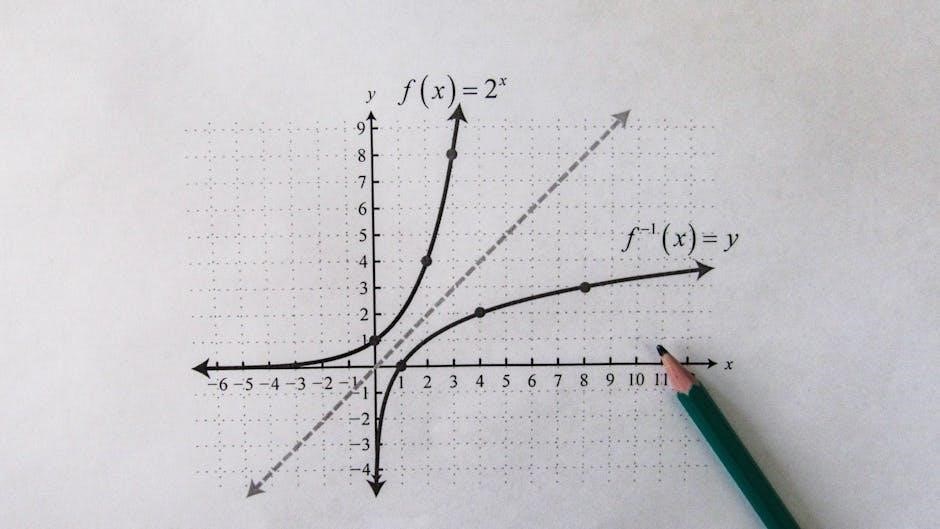
Exponential functions explore growth and decay models, characterized by a constant base raised to a variable exponent․ Students learn to graph exponential functions, analyzing their asymptotes, intercepts, and transformations․ Understanding the properties of exponents is crucial for simplifying expressions and solving exponential equations․
Logarithmic functions are introduced as the inverse of exponential functions, enabling the solving of equations where the variable resides in the exponent․ Logarithmic properties, such as the product, quotient, and power rules, are essential for manipulating logarithmic expressions․
Applications abound in finance (compound interest), science (radioactive decay), and population growth․ The natural logarithm, based on the constant e, is also explored, linking these concepts to calculus and further mathematical studies, building a strong foundation․

Trigonometry Integration
Algebra 2 Honors often integrates trigonometry, introducing functions like sine and cosine, alongside identities and equations, expanding mathematical skills and problem-solving abilities․
Chapter 9: Trigonometric Functions
This chapter marks a significant transition in Algebra 2 Honors, introducing the fundamental concepts of trigonometric functions․ Students delve into the six primary trigonometric functions – sine, cosine, tangent, cotangent, secant, and cosecant – and their relationships within right triangles․
The curriculum typically covers the unit circle, radian measure, and the graphs of these functions, emphasizing their periodic nature and key characteristics like amplitude, period, and phase shift․ Practical applications, such as modeling real-world phenomena with trigonometric functions, are often explored․
Textbooks, whether in traditional or PDF format, will provide numerous examples and exercises to solidify understanding․ Resources like McGraw Hill’s 2008 edition and online platforms such as CK-12 Foundation offer supplementary materials, including interactive applets and practice quizzes, to enhance learning and mastery of these essential trigonometric principles․
Students will learn to evaluate trigonometric functions for specific angles and solve problems involving trigonometric ratios․
Chapter 10: Trigonometric Identities and Equations
Building upon the foundation of trigonometric functions, this chapter focuses on trigonometric identities and their application in solving trigonometric equations․ Students learn to manipulate and simplify trigonometric expressions using fundamental identities like Pythagorean, reciprocal, and quotient identities․
A core component involves verifying trigonometric identities, requiring algebraic skill and a deep understanding of trigonometric relationships․ Solving trigonometric equations, both algebraically and graphically, is also emphasized, often involving techniques like factoring and using the unit circle․
Algebra 2 Honors textbooks, including PDF versions from publishers like McGraw Hill, provide a wealth of practice problems and step-by-step solutions․ Online resources, such as those offered by the CK-12 Foundation, supplement these materials with interactive exercises and video tutorials, aiding in the comprehension of complex concepts and equation-solving strategies․
Mastery of these skills is crucial for success in precalculus and calculus․
Exam Preparation and Resources
Comprehensive exam resources, including semester reviews and practice tests, are vital for success; solutions manuals and online calculators further aid student preparation․
PDF textbooks often include standardized test practice, bolstering confidence and skills․
Final Exam – Semester 1 Review
Preparing for the Algebra 2 Honors Semester 1 Final Exam requires a focused review of foundational concepts typically covered in the initial chapters of the textbook․
Key areas include a thorough understanding of integers, rational numbers, linear equations, and inequalities – often detailed in Chapter 1 and Chapter 2 of resources like McGraw Hill’s 2008 edition․
Students should revisit solving techniques for various equation types, graphing linear functions, and understanding slope-intercept form․
Mastering systems of equations and inequalities, frequently addressed in Chapter 3, is also crucial․
Utilizing the textbook’s practice problems, alongside supplemental materials and online resources, will reinforce these skills․
Accessing a PDF version allows for convenient, searchable review, and the solutions manual provides valuable self-assessment opportunities․
Don’t forget to practice applying these concepts to word problems!
Final Exam – Semester 2 Review
The Algebra 2 Honors Semester 2 Final Exam demands a comprehensive grasp of advanced topics introduced later in the curriculum, building upon the foundations established earlier․
Focus your review on polynomials, rational expressions, radical functions, and exponential/logarithmic functions – core components often detailed in Chapters 5 through 8 of textbooks like McGraw Hill’s 2008 edition․
Ensure proficiency in factoring polynomials, simplifying rational expressions, and solving radical and exponential equations․
A strong understanding of function transformations and their graphs is also essential․
If your course integrated trigonometry, dedicate time to reviewing trigonometric functions, identities, and equations (Chapters 9 & 10)․
Leverage a PDF textbook for easy access to formulas and examples, and utilize the solutions manual for practice and self-assessment․
Practice standardized test questions to build confidence!
Supplemental Materials & Online Calculators
Enhancing your Algebra 2 Honors learning experience extends beyond the core textbook, even in PDF format․ Numerous online resources offer valuable support and practice opportunities․
Explore websites providing additional exercises, video tutorials, and step-by-step solutions to challenging problems․ CK-12 Foundation’s FlexBook offers a collaborative, open-content alternative․
Online calculators, particularly graphing calculators, are indispensable tools for visualizing functions and verifying solutions․ Many websites offer free, emulated versions․
Utilize resources like Polynomial Battleship (Sporcle) for engaging practice․
Financial tools, such as those from Credit Karma, can demonstrate real-world applications of algebraic concepts․
Remember to check your textbook’s companion website for interactive quizzes and downloadable worksheets․
A well-rounded approach, combining textbook study with online resources, maximizes your understanding and exam preparation․
Standardized Test Practice
Success in Algebra 2 Honors often includes preparation for standardized tests, and utilizing your textbook PDF is a great starting point․ Many textbooks, like the McGraw Hill 2008 edition, incorporate dedicated test practice sections․
These sections typically feature full-length practice exams mirroring the format and difficulty of common standardized assessments․
Focus on reviewing key concepts and practicing problem-solving strategies under timed conditions to build confidence and improve speed․
Supplement textbook practice with online resources offering additional practice questions and diagnostic tests․
Pay close attention to the types of questions frequently asked on these exams, such as multiple-choice, grid-in, and short-answer․
Analyze your mistakes to identify areas needing further review and refine your test-taking techniques․
Consistent practice and strategic preparation are crucial for achieving a high score․
Solutions Manuals and Answer Keys
Access to solutions manuals and answer keys is invaluable when working with an Algebra 2 Honors textbook PDF․ These resources provide step-by-step solutions to problems, aiding in understanding complex concepts and verifying your work․

Many textbook publishers offer separate solutions manuals for purchase, while some PDFs may include answer keys directly within the text․
Utilize these resources to identify areas where you struggle and to learn alternative approaches to problem-solving․
However, avoid relying solely on solutions manuals; prioritize attempting problems independently first to foster critical thinking skills․
Check if your textbook’s publisher provides online access to solutions or answer keys as a supplementary resource․
Remember that the goal is not simply to obtain the correct answer, but to understand the underlying mathematical principles․
Effective use of solutions manuals enhances learning and builds confidence․